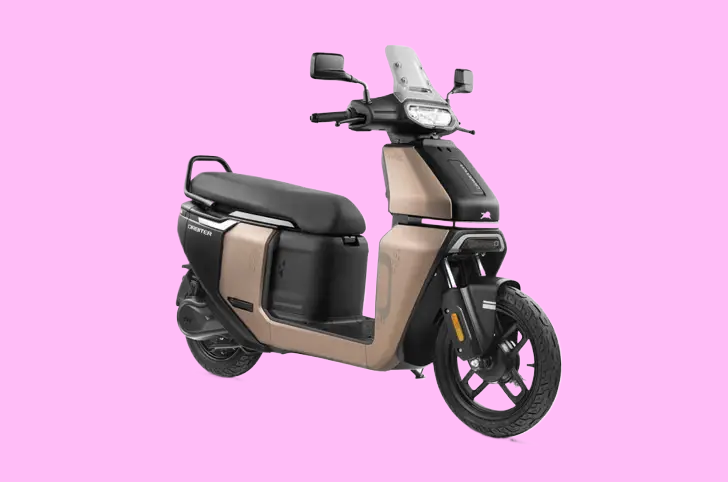
TVS Orbiter V1 Launched at ₹49,999 — Is India’s Cheapest Practical EV Scooter Finally Here?
Sub-₹50,000 for a feature-loaded electric scooter with cruise control, OTA updates, crash detection, and a 5-year warranty. That sentence would have sounded absurd two years ago. On March 12, 2026, TVS Motor Company made it real.
The TVS Orbiter V1 launched today in Lucknow at a headline price of ₹49,999 — ex-showroom Delhi, inclusive of PM e-Drive subsidy, under the company’s new Battery-as-a-Service (BaaS) model. Without BaaS, the same scooter costs ₹84,500. That ₹34,501 gap between two versions of the same vehicle is the most important story in India’s electric two-wheeler market this week — and understanding it is essential before you walk into a TVS dealership.
For context on what this means for your daily running costs: the Orbiter V1’s 1.8 kWh battery will cost approximately ₹10–₹18 per full charge at home, delivering a real-world range of 60–75 km in city conditions. Use our EV running cost calculator to calculate your exact ₹/km figure based on your city’s electricity tariff, and check our EV subsidy calculator to see if additional state-level benefits apply on top of the PM e-Drive subsidy already factored into today’s launch price.
TVS Orbiter V1 — Complete Specs & Features
Core Specifications
| Specification | TVS Orbiter V1 | TVS Orbiter V2 |
|---|---|---|
| Battery Capacity | 1.8 kWh | 3.1 kWh |
| IDC Certified Range | 86 km | 158 km |
| Real-World Range (est.) | 60–75 km | 100–120 km |
| 0–80% Charge Time | 2 hr 20 min | 4 hr 10 min |
| Seat Height | 845 mm | 845 mm |
| Underseat Storage | 34 litres | 34 litres |
| Front Wheel | 14-inch | 14-inch |
| Rear Wheel | 12-inch | 12-inch |
| Ride Modes | Eco + Power | Eco + Power |
| OTA Updates | ✅ | ✅ |
| Price (BaaS, with PM e-Drive) | ₹49,999 | ₹99,900 |
| Price (Without BaaS, with PM e-Drive) | ₹84,500 | — |
What You Get at ₹49,999 — Feature Breakdown
The Orbiter V1 is not a stripped-down budget scooter. TVS has essentially carried over the complete Orbiter V2 feature set — minus battery size — into the V1. That means:
Connectivity & Technology: A coloured LCD instrument cluster shows incoming calls alongside ride data. The companion mobile app enables remote battery charge monitoring, odometer tracking, and turn-by-turn navigation. Over-the-air software updates allow the scooter to improve without a service visit — something that still isn’t standard on many scooters twice this price.
Safety Features: Crash detection, fall alerts, theft alerts, geo-fencing, and time-fencing are all included. For a scooter targeting urban commuters and first-time EV buyers, this level of safety alerting at the ₹49,999 price point is genuinely impressive.
Riding Convenience: Hill Hold Assist, Cruise Control, Parking Assist (reverse function), and regenerative braking in both ride modes. The 845 mm flat-form seat is designed for both rider and pillion comfort — an often-overlooked detail that matters for daily use. The 34-litre underseat storage fits two helmets.
EVCommunity Verdict: At ₹49,999 under BaaS, the Orbiter V1’s feature list embarrasses several scooters priced at ₹80,000–₹1 Lakh. TVS has not cut corners on technology — what they’ve cut is battery size. Whether that trade-off works for you depends entirely on your daily commute distance.
Complete Your EV Research — Free Tools by EVCommunity.in
Making a smart EV decision means looking at the complete picture. Use our EV vs Petrol Cost Calculator to see your real annual savings, then check the EV Subsidy Calculator to find every central and state benefit you qualify for. Plan your monthly finances with the EV Loan EMI Calculator, and understand your day-to-day running expenses using our EV Charging Cost Calculator, Home Charging Calculator, and EV Running Cost per km Calculator. Before you buy or drive, check real-world range with the EV Range Calculator and locate nearby chargers with our EV Charging Stations Finder. Already own an EV? Monitor your battery with the EV Battery Health Checker and stay prepared with the EV Battery Replacement Cost Estimator. All tools are free, India-specific, and community-verified.
The BaaS Model Explained — What ₹49,999 Actually Means
This is the section most launch-day articles will skip over or skim. Don’t skip it — because the BaaS model fundamentally changes how you should evaluate the Orbiter V1’s real cost of ownership.
How Battery-as-a-Service Works
Under TVS’s BaaS model, you purchase the scooter (the vehicle itself, without the battery) at a sharply reduced price — ₹49,999 in the Orbiter V1’s case. The battery is then subscribed to on a monthly basis. Plans start at ₹862/month and are available across three tenure options: 24, 36, or 60 months.
What makes TVS’s BaaS notably better than some competitors:
- No distance restrictions — regardless of which plan tenure you choose, TVS places no cap on how many kilometres you can ride monthly. Some other BaaS offerings in India restrict mileage per plan — TVS doesn’t.
- Extended warranty included — BaaS buyers get a 5-year or 70,000 km extended warranty bundled in. This is significant: battery replacement is the largest potential cost in EV ownership, and this warranty effectively removes that risk for 5 years.
- BaaS is available across TVS’s full EV range — the iQube is also now available under this model, not just the Orbiter.
The Real Total Cost Calculation
Here’s the honest maths that the ₹49,999 headline doesn’t show you:
Option 1 — BaaS (36-month plan):
- Vehicle purchase: ₹49,999
- Monthly subscription: ₹862 × 36 months = ₹31,032
- Total 3-year cost: ₹81,031
Option 2 — Without BaaS (full ownership):
- Vehicle purchase: ₹84,500
- No monthly subscription
- Total 3-year cost: ₹84,500 (before any maintenance)
So after 36 months, the gap is just ₹3,469. With the 5-year extended warranty included in BaaS but not in the standard purchase, BaaS actually delivers more value for most buyers over a 3-year period — particularly given that battery replacement costs for a 1.8 kWh pack could run ₹15,000–₹25,000 if the warranty isn’t in place.
The 60-month BaaS plan changes the maths:
- ₹49,999 + (₹862 × 60) = ₹49,999 + ₹51,720 = ₹1,01,719 total
At 60 months, BaaS costs more in pure rupee terms than outright purchase. However, the 5-year warranty coverage and zero upfront battery cost still make it the right choice for buyers with capital constraints — which is precisely who TVS is targeting.
EVCommunity Verdict: For first-time EV buyers with budget constraints, BaaS is the smarter entry point. For buyers who can afford ₹84,500 upfront and plan to use the scooter beyond 5 years, outright ownership makes more financial sense long-term. Use our EV loan EMI calculator to compare financing the full ₹84,500 against the BaaS monthly commitment.
TVS Orbiter V1 BaaS Plan — Complete Monthly Cost Breakdown (2026)
The ₹862/month figure TVS quotes is just the starting point. Before signing a BaaS agreement, you need to see the full picture — total money out of pocket across all three plan tenures versus simply buying the scooter outright.
BaaS vs Outright Purchase — Total Cost Comparison
| BaaS Tenure | Monthly Cost | Total Subscription Cost | Vehicle Cost | Total 3-Year Cost | Outright Purchase |
|---|---|---|---|---|---|
| 24 months | ₹862 | ₹20,688 | ₹49,999 | ₹70,687 | ₹84,500 |
| 36 months | ₹862 | ₹31,032 | ₹49,999 | ₹81,031 | ₹84,500 |
| 60 months | ₹862 | ₹51,720 | ₹49,999 | ₹1,01,719 | ₹84,500 |
All prices ex-showroom Delhi inclusive of PM e-Drive subsidy. Outright purchase price: ₹84,500.
What This Table Actually Tells You
The 36-month BaaS plan is the sweet spot — total cost of ₹81,031 is actually ₹3,469 less than the outright purchase price of ₹84,500, with a 5-year/70,000 km extended warranty bundled in. Over 24 months, you save ₹13,813 versus outright purchase while keeping capital free.
The 60-month plan costs ₹17,219 more than outright purchase — but spreads the entry cost to just ₹49,999 upfront. For buyers with tight capital, that lower entry barrier is worth the premium over 5 years.
EVCommunity Verdict: The 36-month BaaS plan delivers the best value in pure rupee terms — slightly cheaper than outright purchase with full warranty coverage included. If capital isn’t a constraint, outright purchase at ₹84,500 makes sense beyond 5 years of ownership. Use our EV loan EMI calculator to compare financing the full ₹84,500 at current bank rates versus committing to ₹862/month BaaS.
TVS BaaS vs Competitor BaaS — Key Difference
One detail worth highlighting before you sign: TVS’s BaaS model has no monthly distance cap regardless of which tenure you choose. Some competitor BaaS offerings in India restrict monthly kilometre allowances — meaning heavy riders face hidden overage costs. TVS has explicitly confirmed unlimited distance across all BaaS tenures. Verify this in writing at your dealership before signing the agreement.
TVS Orbiter V1 Battery Replacement Cost — What Happens After Warranty?
This is the question BaaS buyers don’t need to worry about — but outright purchase buyers absolutely should understand before committing.
For BaaS Buyers — Zero Replacement Risk
If you purchase the Orbiter V1 under the BaaS model, TVS’s 5-year or 70,000 km extended warranty covers the battery for the entire subscription period. Battery degradation, capacity loss, or failure within this period is TVS’s responsibility — not yours. This warranty coverage is arguably the strongest financial argument for BaaS over outright purchase, since battery replacement is the single largest potential cost in EV ownership.
For Outright Purchase Buyers — Know the Numbers
The Orbiter V1’s 1.8 kWh battery is a relatively small pack, which works in your favour for replacement cost. Based on current Indian EV battery replacement pricing and the 1.8 kWh capacity:
| Replacement Scenario | Estimated Cost | When It Applies |
|---|---|---|
| Standard manufacturer warranty period | ₹0 | Within warranty terms |
| OEM replacement (post-warranty) | ₹15,000–₹22,000 | After warranty expiry |
| Third-party replacement | ₹10,000–₹16,000 | After warranty expiry |
| Module repair (partial degradation) | ₹5,000–₹9,000 | If only partial capacity lost |
Estimates based on current Indian EV battery market pricing. Actual TVS service pricing may vary.
How Long Will the Battery Last?
In Indian conditions — heat, monsoon humidity, and typical urban stop-start riding — a well-maintained 1.8 kWh LFP or NMC battery at moderate daily usage (40–50 km/day) should retain 80%+ capacity for 4–6 years. Habits that preserve battery life: avoid charging to 100% daily, don’t regularly drain to 0%, use Eco mode in heavy traffic, and prefer overnight home charging over repeated fast charging.
Use our EV battery health checker to understand how battery health degrades over time across different Indian EV models, and our EV battery replacement cost estimator for a detailed breakdown of replacement costs across brands and battery sizes.
EVCommunity Verdict: For outright purchase buyers planning to keep the Orbiter V1 beyond 3–4 years, factor ₹15,000–₹22,000 as a potential post-warranty battery cost into your total ownership calculation. For BaaS buyers — this concern simply doesn’t apply within the subscription period.
TVS Orbiter V1 BaaS Monthly Cost — Full Breakdown
The Orbiter V1’s 1.8 kWh battery is small — and that’s not a criticism. For its target use case (urban daily commute under 60–70 km), it’s sized correctly. And small batteries mean very low charging costs.
Monthly Charging Cost — City Wise
Assuming 40 km daily commute, 26 days/month = 1,040 km monthly. At the Orbiter V1’s real-world efficiency of approximately 15–17 km/kWh, monthly consumption is roughly 65–70 kWh:
| City | Home Charging Rate | Monthly Charging Cost |
|---|---|---|
| Delhi | ₹3.00–₹5.00/unit | ₹195–₹350 |
| Bengaluru | ₹5.75–₹7.20/unit | ₹375–₹504 |
| Mumbai | ₹5.19–₹9.95/unit | ₹337–₹697 |
| Hyderabad | ₹4.50–₹7.50/unit | ₹293–₹525 |
| Chennai | ₹4.50–₹6.50/unit | ₹293–₹455 |
| Ahmedabad | ₹4.35–₹5.50/unit | ₹283–₹385 |
Monthly electricity cost for the same commute on a petrol scooter at March 2026 prices (₹94–₹107/litre): ₹2,200–₹2,900.
Monthly saving vs petrol scooter: ₹1,900–₹2,600 depending on city.
That’s enough to cover the BaaS subscription (₹862/month) and still have ₹1,000–₹1,700 left over as net monthly saving — even after paying the battery subscription fee.
Use our EV charging cost calculator for a more detailed breakdown including home vs public charging split, and our EV home charging calculator to estimate your exact monthly electricity bill increase in your specific city.
TVS Orbiter V1 vs V2 — Which One Should You Buy?
This is the practical question every TVS showroom visitor will face from tomorrow. Here’s an honest comparison:
Choose the Orbiter V1 If:
- Your daily commute is under 60 km (the V1’s 60–75 km real-world range covers this comfortably)
- Budget is a primary concern — ₹49,999 BaaS entry is genuinely compelling
- You charge at home overnight — the V1’s 2 hr 20 min charge time means two charges per day are feasible if needed
- You’re a first-time EV buyer who wants a low-risk, low-capital entry into EV ownership
Choose the Orbiter V2 If:
- Your daily commute is 60–100 km — the V2’s 100–120 km real-world range gives genuine headroom
- You do occasional intercity or extended urban runs
- You want to charge once every 1.5–2 days rather than daily
- The ₹50,000 price difference doesn’t significantly affect your purchase decision
What the V1 and V2 Share (And Why It Matters):
Both scooters have identical seats, storage, wheels, safety features, connectivity, ride modes, and OTA update capability. TVS has not made the V1 feel “lesser” in any dimension except battery size and range. For a commuter who genuinely doesn’t need 158 km of range, the V1 offers identical daily usability at roughly half the BaaS entry price.
TVS Orbiter V1 vs V2 — Which Is Better Value in 2026?
| Scooter | Price (Approx.) | Real-World Range | Battery | Key Advantage |
|---|---|---|---|---|
| TVS Orbiter V1 | ₹49,999 (BaaS) / ₹84,500 | 60–75 km | 1.8 kWh | Lowest entry price, full feature set, no BaaS km limit |
| TVS Orbiter V2 | ₹99,900 | 100–120 km | 3.1 kWh | Better range, same features |
| Ola S1 Air | ~₹79,999 | 90–110 km | 2.5 kWh | Strong range, aggressive pricing |
| Bajaj Chetak 2901 | ~₹95,000 | 90–110 km | 2.9 kWh | Proven reliability, wide service |
| Ather Rizta S | ~₹1.10 Lakh | 100–120 km | 3.7 kWh | Best tech, strongest charging network |
EVCommunity Verdict: No competitor currently offers a feature-complete electric scooter with crash detection, cruise control, OTA updates, and a 5-year warranty for under ₹50,000. The BaaS model is what makes this possible — and TVS’s unlimited-distance policy makes it genuinely usable, not artificially restricted. The Orbiter V1 at ₹49,999 BaaS has no direct competitor at this price point today.
Buying an EV in India in 2026 — What the Orbiter V1 Launch Tells You
PM e-Drive Subsidy Is Still Working
The Orbiter V1’s ₹49,999 launch price is inclusive of the PM e-Drive subsidy — meaning the central government’s EV purchase incentive has been applied before that price is quoted to you. This is important: it means the subsidy is already baked in, and you don’t need to claim it separately at the dealership. Use our EV subsidy calculator to check whether any additional state-level benefits (road tax exemption, state purchase subsidy) apply in your state on top of this price.
The Sub-₹1 Lakh Segment Is Getting Intensely Competitive
TVS’s Orbiter V1 BaaS entry at ₹49,999 directly pressures Ola, Bajaj, and Ather in the urban commuter segment. With OEM-backed unlimited-distance BaaS, 5-year warranty coverage, and a full feature set, the bar for what buyers should expect under ₹1 Lakh has just been raised significantly. If you’re currently comparing options in this segment, wait a few weeks — competitor price responses are likely.
Range Anxiety Reality for the Orbiter V1
Honest take: 60–75 km real-world range from 1.8 kWh requires a realistic assessment of your daily driving. If your commute is 45 km round trip and you charge overnight — the Orbiter V1 works perfectly, every day. If you have an unpredictable schedule with occasional 80–90 km days, you’ll either need mid-day top-ups or should consider the V2. Use our EV range calculator to check how the V1’s battery handles your specific city, commute type, and AC usage before committing.
What the EV Community Is Saying About the TVS Orbiter V1 Launch
The EVCommunity.in forums have been active since this morning’s announcement — and the reaction is strongly positive with a few important caveats being raised by experienced owners.
The dominant sentiment is that the BaaS model is the real story here, not just the scooter. Members who’ve been advising fence-sitters in the sub-₹1 Lakh segment are pointing to the Orbiter V1 BaaS as the first genuinely accessible EV entry point that doesn’t feel compromised. “₹49,999 with cruise control and crash detection is not a budget scooter — it’s a full scooter with a budget entry price,” one member wrote, summarising the mood well.
The main concern being raised in our community is the 60–75 km real-world range for buyers outside major metros. Members from Tier 2 cities who do longer daily commutes or have limited access to public charging are flagging that the V1 needs reliable overnight home charging to work as a daily driver — and apartment charging access remains a genuine friction point in many cities. Our community has step-by-step guides for navigating society NOC processes for EV charger installation, based on real experiences from members in Pune, Bengaluru, and Mumbai housing societies.
Several members are also pointing out that TVS’s no-distance-limit BaaS policy directly addresses the biggest weakness of competitor BaaS offerings — where restricted monthly kilometre allowances created hidden costs for heavier users. This policy difference matters and is worth confirming at your dealership before signing a BaaS agreement.
Come share your thoughts, compare notes with Orbiter V1 test ride experiences, and get city-specific advice from owners already in queue at EVCommunity.in — where the most practically useful post-launch discussion is already underway.