Petrol Diesel Price Today March 2026 | What It’s Costing You vs What EV Owners Pay | EVCommunity
You checked the petrol price this morning. It hasn’t changed — ₹94.77 in Delhi, ₹103.49 in Mumbai, ₹107.46 in Hyderabad. The government says prices are stable for now. Officials confirmed on March 11, 2026 that domestic fuel prices won’t rise unless crude oil crosses $130 per barrel — and with Brent Crude currently hovering around $90/barrel due to the West Asia conflict, that threshold hasn’t been breached yet.
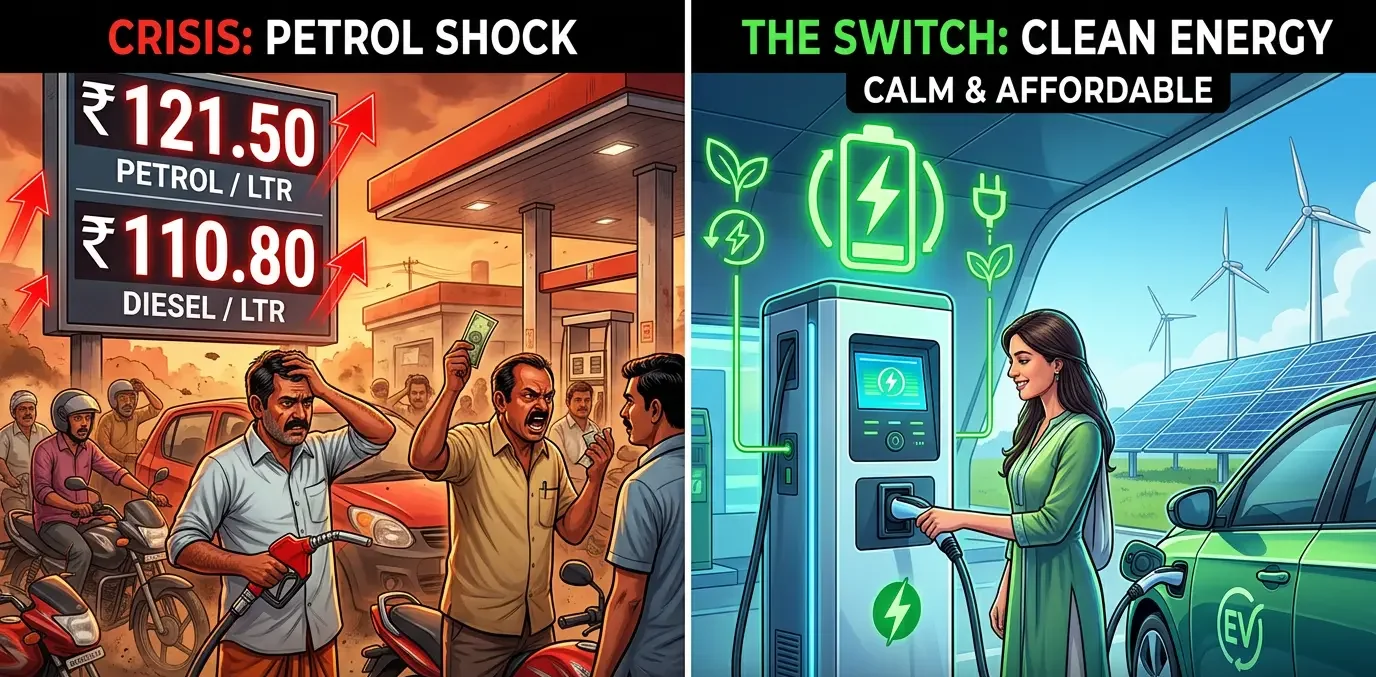
But here’s what that “stable” headline obscures: petrol is already at ₹94–₹107/litre depending on your city. It didn’t get here overnight. And the West Asia conflict driving crude toward $90/barrel is the same conflict that pushed it to $100+ just weeks ago. “Prices won’t rise immediately” is not the same as “prices are fine.” The petrol diesel price today in March 2026 is already costing the average Indian urban commuter ₹6,500–₹7,500 per month in fuel alone — and that’s on a “stable” day.
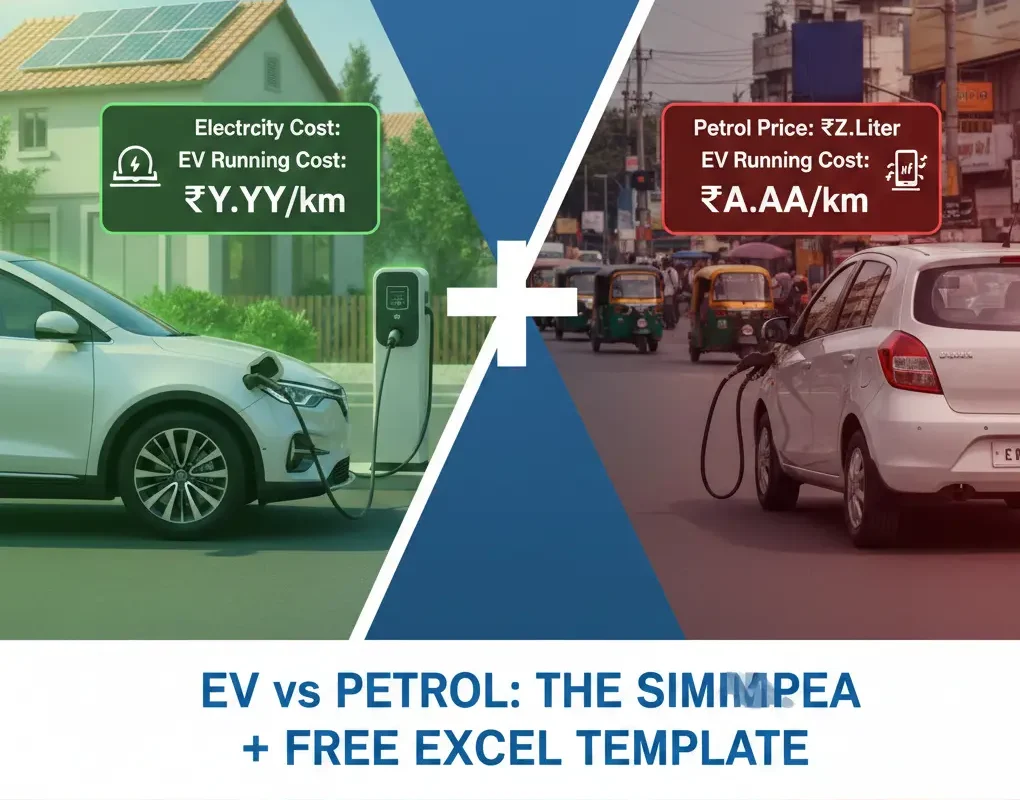
Meanwhile, across the same cities, EV owners are paying ₹800–₹1,500/month in home charging costs for the exact same commute — unaffected by West Asia, unbothered by crude oil, and saving more money relative to petrol drivers with every week the conflict continues.
This guide breaks down the exact ₹ impact of today’s petrol diesel prices on Indian commuters — and what the same journey costs in an EV. Use our EV vs petrol cost calculator to get your personalised saving figure at today’s actual petrol price in your city, and check our EV subsidy calculator to see how much government benefits reduce your EV purchase price right now. All the numbers below are sourced from today’s official fuel prices and real EVCommunity.in member electricity bills — not estimates.
Petrol Diesel Price Today — March 11, 2026 (All Major Cities)
These are the verified retail prices across India as of March 11, 2026, confirmed unchanged by government sources despite the ongoing West Asia conflict:
| City | Petrol (₹/litre) | Diesel (₹/litre) |
|---|---|---|
| New Delhi | ₹94.77 | ₹87.67 |
| Mumbai | ₹103.49 | ₹90.03 |
| Bengaluru | ₹102.92 | ₹88.99 |
| Hyderabad | ₹107.46 | ₹95.70 |
| Chennai | ₹100.80 | ₹92.39 |
| Pune | ₹104.04 | ₹90.55 |
| Ahmedabad | ₹94.48 | ₹90.17 |
| Kolkata | ₹103.94 | ₹92.02 |
| Jaipur | ₹104.72 | ₹90.21 |
| Lucknow | ₹94.69 | ₹87.80 |
| Chandigarh | ₹94.30 | ₹82.45 |
| Patna | ₹105.18 | ₹92.04 |
Source: Economic Times, March 11, 2026. Prices unchanged as per government confirmation.
Why Are Petrol Prices This High in March 2026? The West Asia Context
The current petrol diesel price level in India is directly linked to the ongoing West Asia conflict, which has pushed Brent Crude oil to approximately $90 per barrel — a level that creates significant pressure on India’s fuel economics.
India Imports 85% of Its Crude Oil
India’s dependence on imported crude makes it structurally vulnerable to any Middle East supply disruption. The Strait of Hormuz — through which a significant portion of India’s crude imports travel — sits directly in the region affected by the current conflict. The government has confirmed it is actively diversifying crude sourcing to routes outside the Strait of Hormuz to reduce this exposure. But diversification takes time, and the price pressure is real today.
The $130 Threshold — What It Means for You
Government sources have stated that domestic petrol diesel prices will remain stable as long as crude stays below $130/barrel. That’s reassuring in the short term — oil marketing companies like Indian Oil, BPCL, and HPCL can absorb losses at $90/barrel crude for a period. But it’s worth noting: analysts cited in current market reports expect crude to test $100/barrel if the West Asia conflict intensifies further. At $100 crude, the government’s buffer narrows significantly. At $130, retail prices would rise sharply and quickly.
The Honest Risk Assessment
“Stable today” is not “stable forever.” The $130 trigger is a government-stated threshold — not a market-determined ceiling. The same officials confirming price stability today are also confirming they’re monitoring the situation “closely” and have accelerated crude import diversification. That’s the language of managed uncertainty, not genuine confidence. Plan your personal fuel economics accordingly.
What Today’s Petrol Price Is Costing Indian Commuters — Real Monthly Numbers
Let’s translate today’s petrol prices into actual monthly rupee impact. Assumptions: 40 km daily commute, 26 driving days per month = 1,040 km monthly, petrol car averaging 15 km/l in city conditions = 69.3 litres monthly consumption.
Monthly Petrol Cost at March 11, 2026 Prices
| City | Petrol Price | Monthly Fuel Cost | Annual Fuel Cost |
|---|---|---|---|
| New Delhi | ₹94.77 | ₹6,568 | ₹78,816 |
| Mumbai | ₹103.49 | ₹7,172 | ₹86,064 |
| Bengaluru | ₹102.92 | ₹7,132 | ₹85,584 |
| Hyderabad | ₹107.46 | ₹7,447 | ₹89,364 |
| Chennai | ₹100.80 | ₹6,985 | ₹83,820 |
| Pune | ₹104.04 | ₹7,210 | ₹86,520 |
| Ahmedabad | ₹94.48 | ₹6,547 | ₹78,564 |
| Jaipur | ₹104.72 | ₹7,257 | ₹87,084 |
Based on 40 km daily, 26 days/month, 15 km/l city efficiency, 69.3 litres monthly.
A Hyderabad commuter is spending ₹7,447 every single month just on petrol for a routine 40 km daily commute. That’s ₹89,364 per year — enough to cover nearly 5 months of EMI on a Tata Tiago EV.
What the Same Commute Costs an EV Owner in March 2026
Same commute. Same 1,040 km per month. Completely different cost.
Monthly Home Charging Cost — EV vs Petrol at Today’s Prices
| City | Petrol Car Monthly | EV Monthly (Home Charging) | Monthly Saving | Annual Saving |
|---|---|---|---|---|
| New Delhi | ₹6,568 | ₹780–₹900 | ₹5,668–₹5,788 | ₹68,016–₹69,456 |
| Mumbai | ₹7,172 | ₹1,100–₹1,900 | ₹5,272–₹6,072 | ₹63,264–₹72,864 |
| Bengaluru | ₹7,132 | ₹1,100–₹1,380 | ₹5,752–₹6,032 | ₹69,024–₹72,384 |
| Hyderabad | ₹7,447 | ₹960–₹1,440 | ₹6,007–₹6,487 | ₹72,084–₹77,844 |
| Chennai | ₹6,985 | ₹960–₹1,250 | ₹5,735–₹6,025 | ₹68,820–₹72,300 |
| Pune | ₹7,210 | ₹1,100–₹1,650 | ₹5,560–₹6,110 | ₹66,720–₹73,320 |
| Ahmedabad | ₹6,547 | ₹840–₹1,060 | ₹5,487–₹5,707 | ₹65,844–₹68,484 |
EV costs based on Tata Nexon EV, 6 km/kWh efficiency, 85% AC home charging efficiency, city DISCOM domestic tariff.
EVCommunity Verdict: A Hyderabad EV owner doing 40 km daily saves ₹72,000–₹77,000 per year purely on fuel costs versus a petrol car equivalent — at today’s verified March 2026 prices. Use our EV vs petrol cost calculator with your exact daily distance and city for a personalised figure.
The Insight Every Petrol Car Owner Needs to Hear
Here’s what gets missed in every petrol price news article: EV savings grow every time petrol prices rise — automatically, without you doing anything.
When petrol was ₹80/litre in 2020, an EV owner in Delhi saved roughly ₹3,200/month versus a petrol equivalent. At ₹94.77 today, that same owner saves ₹5,668/month. If crude crosses $100/barrel and petrol reaches ₹110 in Delhi — a scenario government officials themselves have flagged as possible if the West Asia conflict worsens — the monthly saving crosses ₹6,500.
The West Asia conflict that’s worrying every petrol car owner in India right now? EV owners are watching that news with complete financial indifference. Their monthly transport cost doesn’t move when Brent Crude moves. India’s domestic electricity tariffs are set by state DISCOMs — not by OPEC, not by the Strait of Hormuz, not by any geopolitical conflict.
That structural insulation from global oil price volatility is not a small benefit. It’s the defining financial advantage of EV ownership in a world where the West Asia situation remains unresolved.
The Honest Break-Even Calculation at March 2026 Petrol Prices
Let’s answer the real question directly: how long before the EV pays for its own price premium?
Tata Nexon EV vs Nexon Petrol — March 2026
- Nexon EV on-road (Bengaluru): approximately ₹17 Lakh
- Nexon Petrol on-road (Bengaluru): approximately ₹11.5 Lakh
- Price premium: ₹5.5 Lakh
- Monthly fuel saving at ₹102.92 petrol (Bengaluru, 40 km/day): ₹5,892/month
Break-even on fuel alone: ₹5,50,000 ÷ ₹5,892 = 93 months = 7.8 years
That’s before subsidies and maintenance savings. Now factor both in:
After Karnataka road tax exemption + EMPS subsidy (~₹1.2 Lakh reduction): Effective premium: ₹4.3 Lakh → Break-even: 6.1 years
Add annual maintenance saving of ₹15,000–₹25,000: Effective monthly total saving: ₹7,100–₹8,000 → Break-even: 4.5–5 years
And that’s at today’s petrol prices. If crude reaches $100/barrel and petrol hits ₹110 in Bengaluru — which government sources consider a real possibility — break-even drops to under 4 years.
Use our EV subsidy calculator to find your exact subsidy benefit and our EV loan EMI calculator to plan your monthly outgo — the combined picture is more favourable than most people expect.
Best EVs to Buy Right Now Given March 2026 Petrol Prices
Fastest Break-Even — Tata Tiago EV
Price: ₹8.19–₹11.99 Lakh | Real-world range: 180–210 km | Home charging cost/km: ₹0.95–₹1.25
Honest take: the Tiago EV is the most financially compelling car purchase in India at March 2026 petrol prices. The premium over a comparable petrol hatchback is ₹2–3 Lakh. At ₹103–₹107 petrol, a Mumbai or Hyderabad buyer breaks even in 3–4 years on fuel savings alone — without counting a single rupee of subsidy. For a Delhi buyer with state subsidies applied, it’s closer to 2.5 years. Nothing else in the Indian market offers this ROI right now.
Best All-Rounder — Tata Nexon EV
Price: ₹14.49–₹19.49 Lakh | Real-world range: 270–310 km | Home charging cost/km: ₹1.10–₹1.40
The Nexon EV remains India’s most trusted electric car — LFP battery chemistry, India-wide Tata service network, and proven real-world performance from hundreds of community members with 50,000+ km on their odometers. At today’s petrol prices, the ROI case is the strongest it’s been since launch.
Best Two-Wheeler ROI — TVS iQube ST
Price: ₹1.64 Lakh | Real-world range: 130–150 km | Home charging cost: ₹0.55–₹0.70/km
At Hyderabad’s ₹107.46 petrol and a petrol scooter averaging 45 km/l, you’re paying ₹2.39/km in fuel. The iQube ST costs ₹0.62/km at home charging. For a 40 km daily commuter, that’s a saving of ₹714/month — meaning the iQube ST’s price premium over a petrol scooter pays back in under 15 months. Use our EV running cost calculator to see your exact ₹/km figure.
What the EV Community Is Saying — March 2026
The West Asia conflict and petrol price news has generated more traffic to our community forums than any event since the 2022 fuel price spike. The mood among existing EV owners is one of quiet, vindicated calm. The mood among people still driving petrol cars is noticeably more anxious.
EV owners across our community consistently share one theme right now: every West Asia conflict headline is a reminder of why they made the switch — and every “petrol prices stable for now” update just underlines how fragile that stability is. Members who bought EVs in 2022–24 are watching their break-even timelines shrink in real time as petrol prices stay elevated.
A community member from Hyderabad shared her March 2026 numbers in our forum this week — Tata Nexon EV, 48 km daily commute, TSSPDCL home charging at ₹5.50/unit. Monthly electricity cost for EV charging: ₹1,140. Her previous petrol car on the same route cost ₹7,640/month at today’s ₹107.46 Hyderabad petrol price. Monthly saving: ₹6,500. “The West Asia conflict news doesn’t stress me anymore,” she wrote. “It used to. Now I just check the crude oil price, note that it’s going up, and feel very comfortable about my purchase decision.”
Another member from Delhi — a TVS iQube ST owner commuting 35 km daily — posts his monthly electricity bill regularly. March 2026: ₹196 for the full month. His colleague in the same office, same distance, same days: spending ₹2,890/month on petrol. Same road. Completely different financial reality.
Join the conversation, share your own March 2026 numbers, and get city-specific EV advice at EVCommunity.in.
Frequently Asked Questions — Petrol Diesel Price Today March 2026 & EV Savings
Q: How much does the same commute cost in an EV at March 2026 electricity rates? An EV owner doing the same 40 km daily commute with home AC charging pays approximately ₹780–₹900/month in Delhi, ₹960–₹1,440 in Hyderabad, ₹1,100–₹1,380 in Bengaluru, and ₹1,100–₹1,900 in Mumbai. That’s 85–90% less than the equivalent petrol cost at today’s March 2026 fuel prices. The effective per-km cost for home-charged EVs is ₹1.00–₹1.55 versus ₹6.30–₹7.16 for petrol — at today’s verified city prices. Use our EV running cost calculator for your exact ₹/km figure.
Q: How do I calculate my exact EV saving at today’s petrol price in my city? Use our EV vs Petrol Cost Calculator — enter today’s petrol price in your city (from the table above), your current car’s mileage, your daily driving distance, and your EV model of interest. The calculator outputs your personalised monthly saving in ₹ adjusted for your city’s electricity tariff and realistic EV efficiency. It takes under 60 seconds and uses today’s actual figures — not outdated national averages.
Q: What government subsidies can reduce my EV purchase cost right now in March 2026? Central EMPS 2024 subsidies of ₹5,000–₹50,000 apply to approved electric two-wheelers and three-wheelers. State subsidies in Delhi, Gujarat, Maharashtra, and Karnataka add ₹20,000–₹1.5 Lakh in purchase benefits plus road tax and registration fee exemptions. Section 80EEB of the Income Tax Act provides up to ₹1.5 Lakh annual deduction on EV loan interest. Combined, these can reduce your effective EV purchase cost by ₹80,000–₹2.2 Lakh. Use our EV subsidy calculator to find every benefit you qualify for before purchasing.
The Bottom Line — March 2026 Petrol Prices Have Made the Case Unanswerable
We’ve covered today’s verified petrol diesel prices across 12 Indian cities, the West Asia conflict context and $130 crude threshold, exact monthly fuel costs at today’s prices for a 40 km daily commuter, the full city-wise EV vs petrol saving comparison, honest break-even calculations including subsidies and maintenance, the three best EVs for ROI at current petrol prices, and 10 real FAQs on the petrol price situation and EV economics.
Your one clear next step: open the EV vs Petrol Cost Calculator, enter today’s petrol price from your city in the table above, and get your personalised monthly saving figure. The numbers in this article — ₹5,600–₹6,500/month in fuel savings — are city averages. Your specific number might be higher or lower. Know your number before you make any decision.
Share your March 2026 fuel bill, your EV saving calculation, or your switch story at EVCommunity.in. Every real number shared makes the case for the next person sitting on the fence — and there are a lot of them, watching the West Asia news and quietly doing the maths.
The West Asia conflict is unpredictable. Crude oil prices are unpredictable. Your electricity bill is not. That’s the EV argument in one sentence — and in March 2026, it’s never been more accurate.
Published: March 11, 2026 | Petrol/diesel prices sourced from Economic Times, March 11, 2026. Crude oil price: approximately $90/barrel (Brent). EV charging costs based on EVCommunity.in member electricity bills and state DISCOM tariff orders. Government fuel price stability statement sourced from ANI via Economic Times.